
Aldine is an open-source, self-hosted LaTeX collaboration platform — an Overleaf alternative — that installs as two containers and keeps every project as a real git repository. It is AGPL-3.0, at v0.11.0 this week, and young enough that the README says the rough-edges part out loud.
What you get
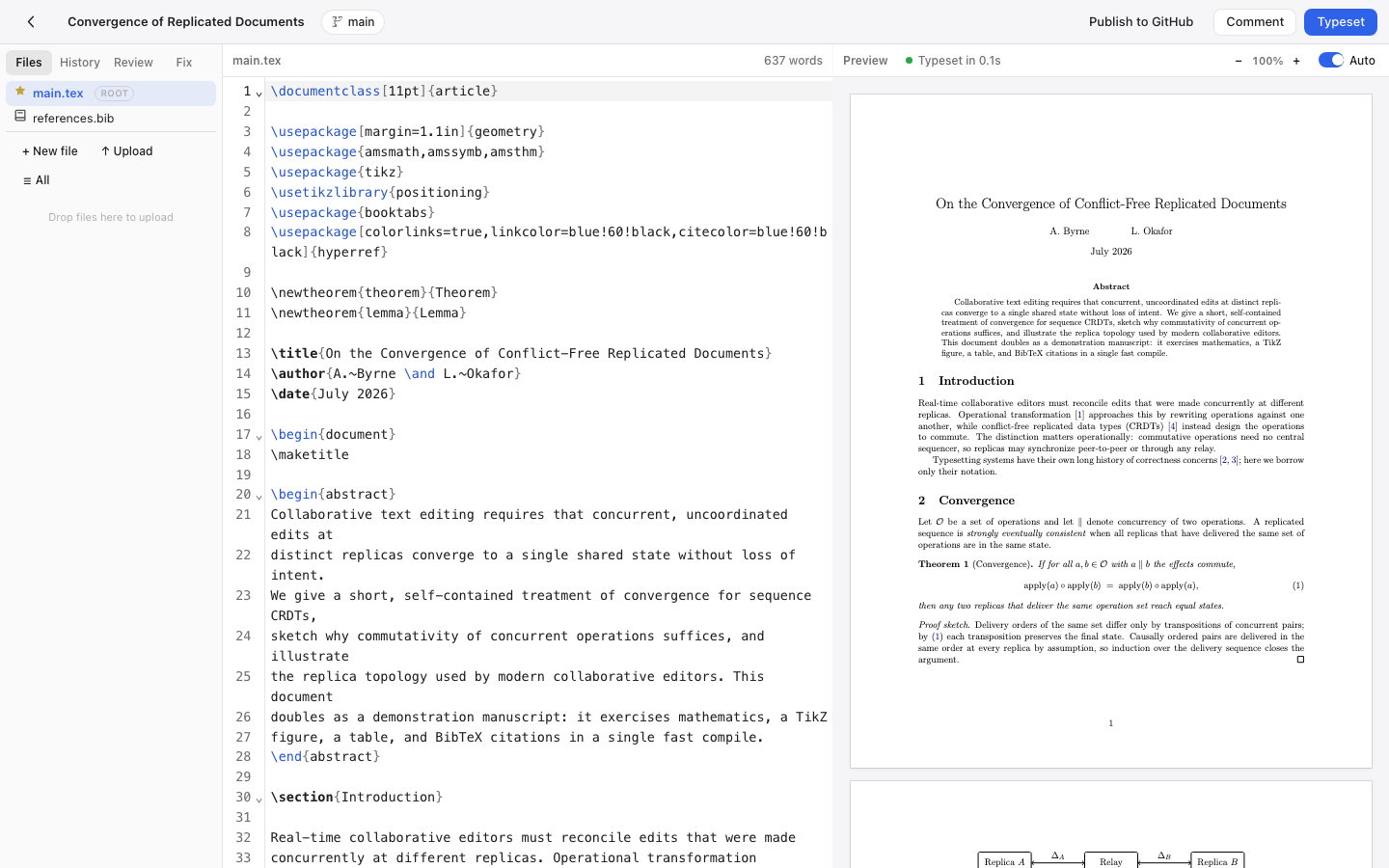
Real-time editing with multiple cursors, built on Yjs CRDTs, with no cap on collaborators. Every project is a git repo: create branches, edit them independently, merge back, all from the UI. Publish a project to GitHub, GitLab, Gitea or Forgejo and a co-author can clone it and use VS Code; their commits come back with one Pull, and pull or merge requests open from the editor. Overleaf projects import as ZIPs (root file detected, first typeset automatic), and Zotero links natively, your whole library or a single collection, with no premium tier in the way.
Compiles run TeX Live and latexmk in a no-egress container with restricted shell-escape, on persistent caches: about two seconds for a warm recompile, with errors surfaced as line numbers you can click. The installer is the repository’s own compose file: two containers, one volume, no database. Everything else (auth, SSO, email, Postgres and Redis for scale) is opt-in. One caveat: the first pull is big. The compiler image carries about 1.1 GB compressed, 4.3 GB on disk, with TeX Live’s medium scheme plus the publisher classes and non-CJK scripts.
Claude as a collaborator, optionally
With MCP turned on, you can connect the instance to claude.ai, Claude Desktop or Claude Code; the model edits, typesets and shows the PDF in the chat, and every change lands as a git commit authored “Claude” with a review-and-revert prompt in the editor. It is off by default.
The parts that are stated plainly
The README says two things early because finding them out later would feel like a bait-and-switch: a hosted Aldine service is planned, and contributions come in under a CLA that permits relicensing, so a commercially licensed edition is possible. What it commits to: the self-hosted edition stays AGPL-3.0, and nothing that works today moves behind a paid tier.
It is also pre-1.0. A minor version bump may change behavior or on-disk layout; upgrades across minors are not yet tested against existing data, so the advice is to back up first. Only the latest release gets security fixes. Every release is built from a commit that passed CI and is made to typeset a real document before :latest moves.
My read
The README even gives the incumbent cover: “If Overleaf CE fits you, use it; it’s good software.” What it bets on instead is shape: two containers, papers that are git repos, and the Zotero and track-changes set with no paywall, in something small enough to hold in your head. The pre-1.0 warnings and the big first pull are the price. It is a fair one for a lab that already runs containers.
Source: the repository (README and releases) and aldine.dev.