
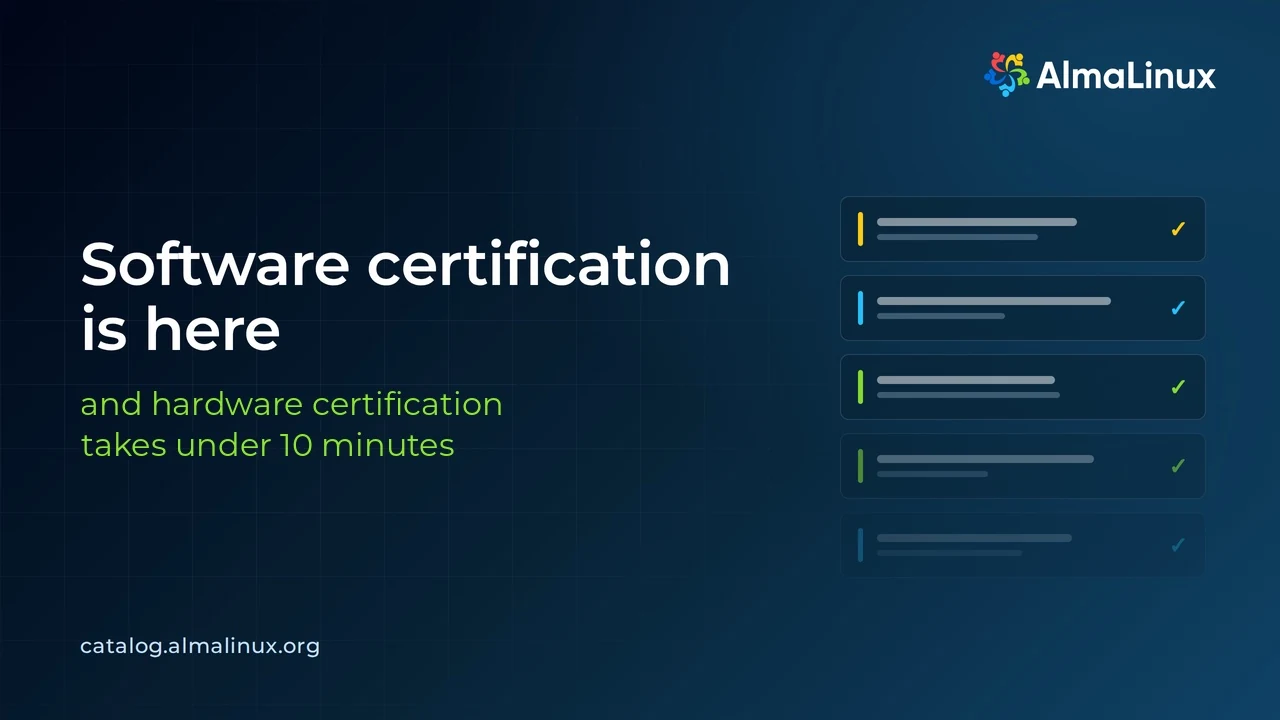
Two years after AlmaLinux announced its certification program, the three things it said were missing have arrived: software certification, self-service toolkits, and a way to certify a machine without installing AlmaLinux on it first. All of it lands in a new catalog at catalog.almalinux.org.
Software joins hardware
Software certification works the way you would ask for it: a publisher lists a product and the releases it supports, and anyone with an AlmaLinux account can confirm a product works on the release they run. Every submission goes through review before it appears, and each listing says who tested it, whether that is the vendor, the AlmaLinux OS Foundation, or a community member. Validations stack, and they are tracked per major version, so a check on 9 does not quietly imply 10.
Hardware, in under ten minutes
The hardware suite is a full rewrite. alma-certify replaces the older Ansible-based tooling, ships in the extras repository as dnf install alma-certify, and runs on the machine being certified. You do not need AlmaLinux installed: boot the live media, run the suite, put the machine back. Most runs finish in under ten minutes, and running the command with no arguments walks you through the options and builds the right invocation for you.
Registering a machine is a code shown on the certified machine that you approve from a browser or by scanning a QR code. The suite takes a normalized inventory (CPUs, memory, disks, network cards, GPUs, firmware, drivers), and benchmarking is now an option rather than a default. When you run it, the results feed public leaderboards.
What the catalog is not
The catalog carries systems, components, software, benchmarks and validations, all available through a public, read-only API so you can pull it into your own tooling. Vendors can even submit hardware they have not announced yet and set the date it becomes public.
One clarification the Foundation bothers to make, because the word gets used loosely: this is a statement about compatibility, not a regulatory certification. FIPS 140-3 and Common Criteria are separate programs.
Where you come in
The program is deliberately open to ordinary machines, and the Foundation says what it wants most: the desktops and servers that exist in the thousands, laptops, workstations and the GPUs in them, anything on aarch64, the creative tools from DaVinci Resolve to OBS, and whatever you run in production. Validations stack, so confirming something already listed helps as much as being first.
My read
All three gaps named two years ago are closed at once, and the important part is how cheap the filing got: a browser confirmation for software, ten minutes of live media for a machine. A catalog is only worth what gets filed, so the Foundation has aimed its ask at the machines people actually run. That ask is where this succeeds or stalls.
Source: AlmaLinux’s announcement post and catalog.almalinux.org.