

Floci answers on port 4566 with 119 AWS services. Point an SDK, the CLI, Terraform, CDK or a test suite at http://localhost:4566 and the calls land in software on your own machine. No account, no API key, no auth token.
It is the AWS member of a family: floci-az does Azure on 4577, floci-gcp GCP on 4588, floci-oci OCI on 4599. Each is a standalone MIT-licensed image, and the AWS one is a drop-in replacement for LocalStack: same port, same wire protocols, swap the image and keep going.
What a local cloud includes
The service list runs from S3, SQS and DynamoDB to Cognito, CloudFront and Step Functions. Where a mock would show, Floci runs real engines in Docker: Lambda functions execute in real AWS runtimes, RDS answers from actual PostgreSQL, MySQL or MariaDB containers, ElastiCache proxies a real Valkey or Redis, EKS spins up a k3s cluster, MSK runs Kafka via Redpanda, ECS and EC2 run containers, and Athena runs SQL on a DuckDB sidecar. Those parts want the Docker socket passed into Floci’s container.
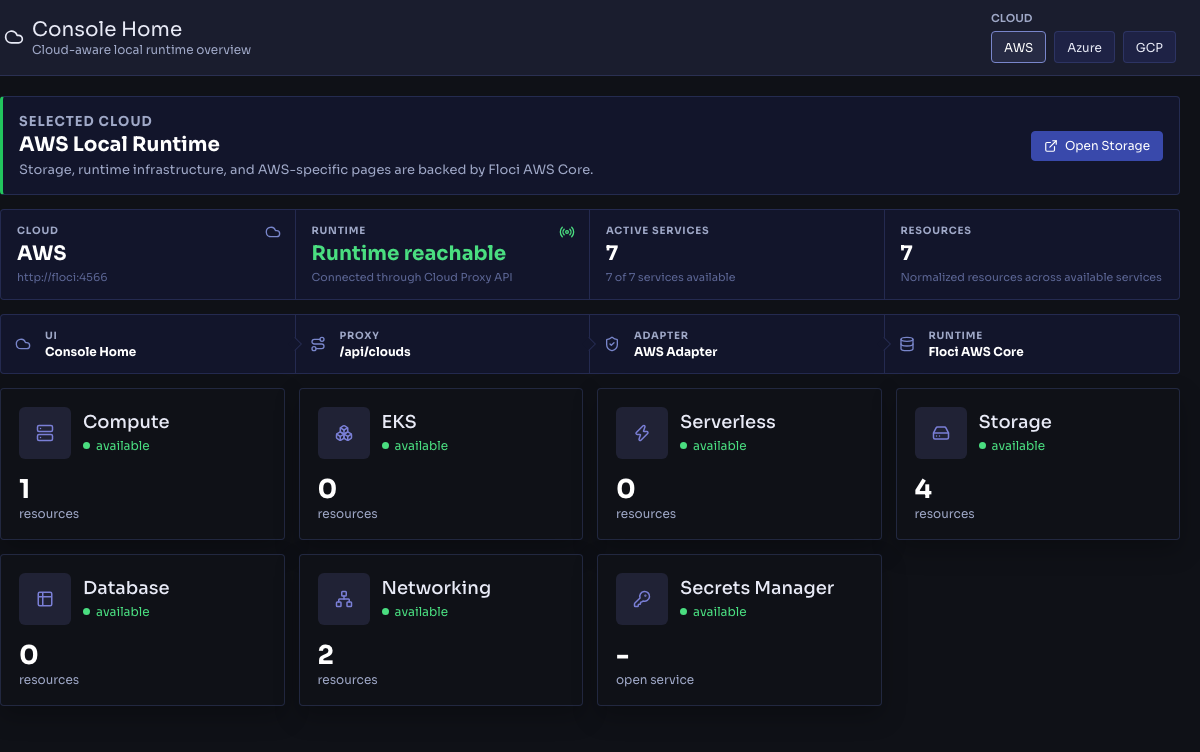
The rest of the setup: a console at /_floci/ui to browse what you created, a CLI that starts the emulator and exports the environment (floci start, then eval $(floci env)), storage modes from in-memory to a write-ahead log, and multi-account isolation, where an access key that is twelve digits becomes that account’s ID.
The comparison it is asking for
Floci’s stated reason for existing is LocalStack’s community edition: LocalStack’s own announcement said the unified image would require an auth token from March 2026, and the community build would stop receiving regular updates and security patches. The project’s own table puts startup at about 24 ms against 3.3 seconds, idle memory at 13 MiB against 143, and the image at 90 MB against a gigabyte. It is sponsor-funded, with the line that sponsorship buys gratitude and nothing else.
Under the headline numbers, depth varies, and the documentation says so: Bedrock’s runtime answers with dummy responses, Textract and Transcribe are API-compatible stubs, and EKS and DocumentDB carry a mock mode. The engines above are the ones made real; the rest is compatibility you can develop against.
Where it is young
The repository dates to February 2026 and sits above 25,000 stars. Version 2.1.0 landed on 15 September, releases ship on the first and third Tuesday of each month, with nightly tags tracking main. That cadence is the thing to weigh: a fast-moving project on a compatibility surface this wide will have soft spots, and its strongest claim, a compatibility suite of 2,576 tests across five SDKs and three infrastructure tools, is the project grading its own homework.
My read
The interesting part here is the business story. A tool many teams ran for free moved behind an auth token, and the answer was a replacement built in the open and handed out under MIT. The dev loop is the easiest thing to put on your own metal, and the one where a rug pull costs the most. If your homelab or CI touches AWS, this is the box that runs the code without shipping a key to anyone.
Source: floci.io and the project repository.