

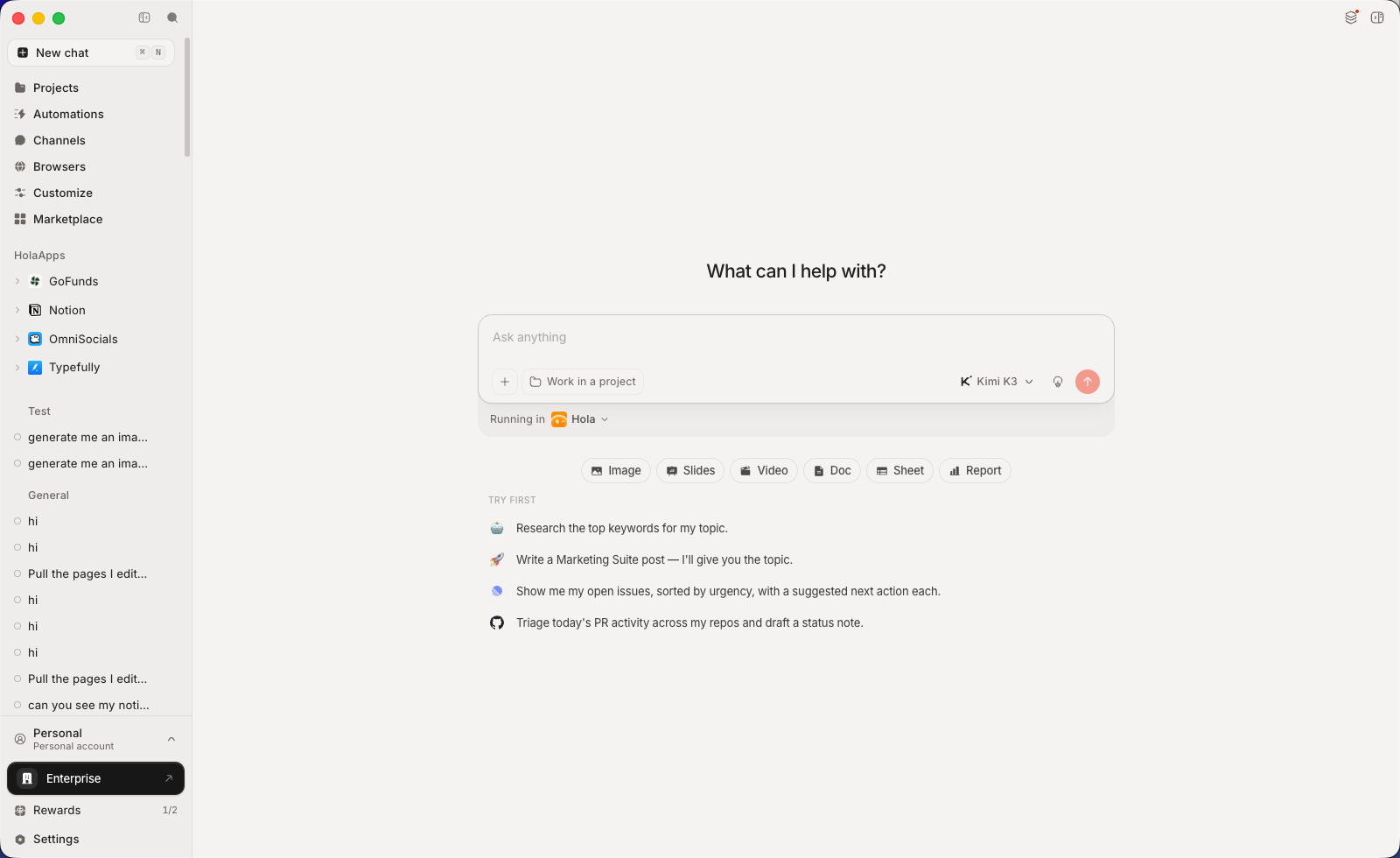
HolaOS is an open-source workspace where an agent and your apps share the screen. Apps open as live UIs next to the agent instead of as chat transcripts, you can watch it work inside one and take over, and the app you point it at can be anything with a URL or an MCP server. The in-workspace marketplace installs them in a click.
The design choices worth naming: chat tools like Slack, Feishu, DingTalk and WeChat connect with access granted per tool and per scope; one shared memory is kept locally as plain files you can read and edit, so switching between agents does not reset context; Claude Code, Codex and the built-in agent all run over the same tools, keys and memory; and 50-odd integrations (Gmail, Notion, GitHub, Linear) connect over OAuth.
What local-first means here, exactly
The repository’s own words: workspace files, memory, embeddings and session history live on your own disk, and there is no copy on the company’s servers. The models are a separate question. The desktop app ships with frontier models built in through a HolaOS account, and bringing your own keys for OpenAI, Anthropic or any compatible endpoint is the alternative. A compatible endpoint can be something you run yourself, which is the path that keeps inference local too.
Install is one line on macOS, Linux or WSL: a curl piped into bash from the repository, or a manual path if you want to read the steps. The app is Electron, the runtime TypeScript, and the repository lists 11,363 stars and 725 forks since it was created in March.
The licence is where “open source” gets specific
The LICENSE file is Apache 2.0, modified. Commercially it is permissive in one direction and strict in the other: internal use inside a single organisation is fine, multiple workspaces included, but you may not use the source to provide a hosted service to third parties, or embed it as a component of a product that is sold or distributed commercially to third parties, without a written commercial licence. You also may not remove or modify the logo or copyright notices in the frontend, and contributors agree the producer can tighten or relax the terms later.
That is the shape of several agent projects this year: source you can read and run, with the hosted-business exclusion carved out. For a homelab it changes nothing. For anyone who was sizing it up as the base of a product, it changes everything.
My read
Two ideas here are worth stealing whatever you think of the product: memory as a folder you can read and edit, and every action approved per scope rather than a settings page you trust once. Both are the opposite of how most agent tools store trust. Run it if the desktop shape suits you, and read the licence before you build a business on it.
Sources: the holaOS README and LICENSE file (holaboss-ai/holaOS), and the repository’s metadata