

HouseOS opened its doors with a 1.0.0 release and an unusual pitch: your home’s own app. One computer at home runs it in Docker and everyone else opens a browser: films, music, games, files, the household board and an AI assistant called Nox. It is MIT licensed, ships no media and no accounts, and the install is the part people pass around: open the folder in a coding agent, paste “Install HouseOS here and set it up with me”. Or clone it and run ./houseos.sh install. Requirements: 64-bit Linux, a Raspberry Pi 4 or 5, or Windows 11 with WSL 2, Docker Engine, 4 GB of memory (8 on Windows) and about 30 GB of disk. Install takes ten to twenty minutes, longer on a Pi.
What actually runs in it
Films arrive through a Stremio add-on and a debrid service, the recommended path, or Jellyfin, your own files, or a torrent player, and cast to Chromecast, Google TV and Android TV. Music takes YouTube and SoundCloud links and fifty thousand radio stations; songs get kept on the house disk after their first play. Games cover about thirty consoles in the browser, GameCube-tier ones on the TV through Moonlight. The household board holds tasks, groceries, a wall, a calendar and chat; Nox answers “why is there no sound” and changes settings behind a confirm card. Under the hood: one FastAPI and MariaDB stack, built from source on your machine.
Where Home Assistant comes in
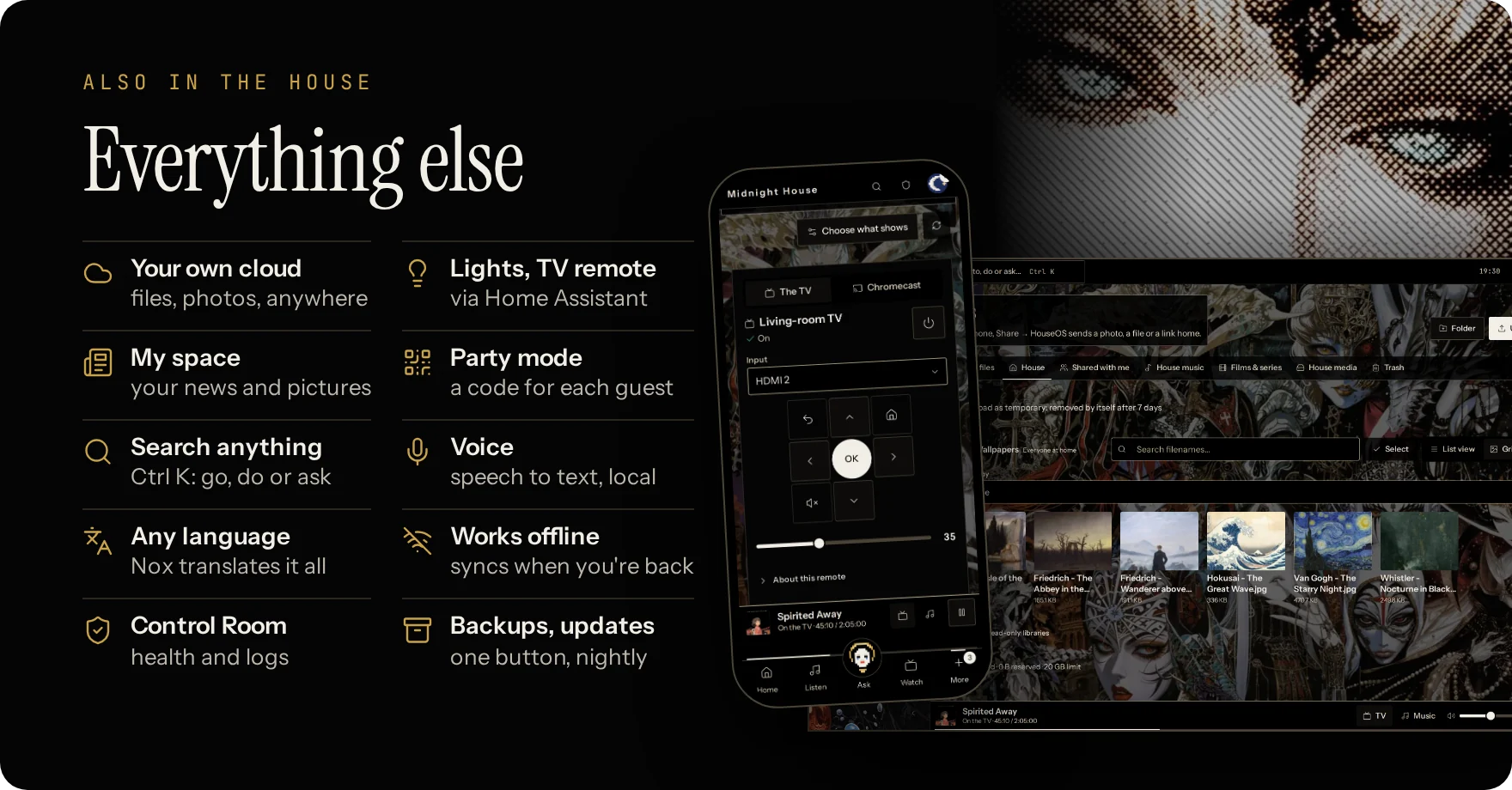
HouseOS does not talk to devices itself. Its smart-home column (lights, plugs, blinds, heating by room, scenes, the TV’s power and input) runs through Home Assistant, connected in the Control Room. This is not a Home Assistant replacement and does not try to be one: no integrations catalogue, no automation engine of its own. HouseOS promises nothing plays, casts or turns on by itself, and locks, alarms and sirens wait for an extra tap. Home Assistant is built around things happening by themselves; HouseOS is built around your household asking.
They stack rather than compete. Home Assistant stays the device layer; HouseOS is the app the household actually opens. Run both and HouseOS borrows Home Assistant for the lights and the TV remote. Skip it and HouseOS skips one section; the rest still works.
First release, first impressions
The honest caveat is the version number: 1.0.0, the first release, with every release installed on a clean machine before it ships. That is a good habit on a young track record. It needs Docker Engine, not Docker Desktop; Macs can browse but not host it; voice typing gets a GPU when you have one. The AI parts are optional, and every feature has its own buttons.
My read
The comparison will come up first, and the answer is that these are not rivals: HouseOS borrows Home Assistant rather than competing with it. The install-by-agent idea is worth watching, because it turns setup from a weekend into a conversation. Version 1.0.0 with one changelog entry behind it: treat the first weekend as a trial, not a migration. The media stack alone earns the disk space, even if the lights stay where they are.
Source: the HouseOS repository.