

openSUSE Leap 16.1 hit release candidate, and the headline feature is one the installer can now offer: Immutable Mode, a read-only root with transactional updates, snapshots and rollback. It is the first Leap to have it, and it is the official successor to Leap Micro, which will not get a 6.3 or a 7.0.
What Immutable Mode is
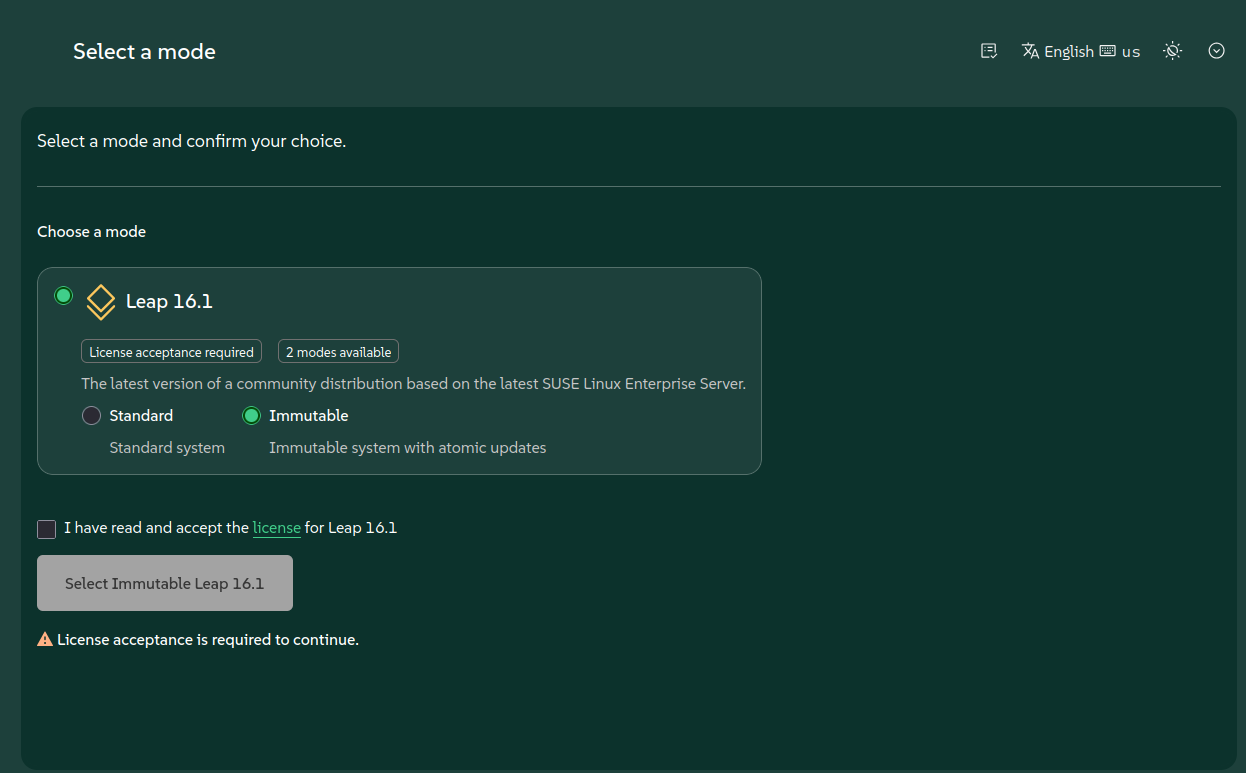
The system boots from a read-only root filesystem and updates through transactional-update: every update lands in a new snapshot, a reboot boots into it, and transactional-update rollback goes back if the update was a bad idea. Additional software is meant to arrive as containers, through podman or distrobox, or as Flatpaks on the desktop; transactional-update pkg install still works for the cases that need it. You boot the normal Leap image and pick the mode in the installer; nothing else about the download changes. The installer is Agama, and the mode is one radio button in a familiar flow.
The Leap Micro carryover
Leap Micro users keep their world. The preconfigured appliances are back in the alternative downloads: the Self-install image for USB, KVM/Xen, Hyper-V, VMware, Harvester, Cloud, and a fully encrypted raw disk. They still configure on first boot through Ignition or Combustion. Existing Leap Micro 6.2 machines can migrate with opensuse-migration-tool, run from a transactional-update shell; the tool is described, carefully, as still experimental, so the instructions say backup.
The rest of the release
GNOME stays at 48 — 16.1 is the bug-fix half of the two-release cycle, with gnome-shell at 48.8 — while KDE users get a real bump, from Plasma 6.4 to 6.6 with Qt 6.11 and KDE Frameworks 6.25. LXQt moves to 2.4, and Xfce keeps 4.20 on Wayland. The release day will be synchronized with SUSE Linux Enterprise Server 16.1 so there is no gap in maintenance updates afterward, a decision the Leap 16.0 retrospective pushed for; the announcement says it may mean a slight delay. RC builds land roughly weekly until SUSE’s Gold Master starts the final countdown.
Package versions are now a tool: the openSUSE version diff page compares Leap 16.1, Leap 16.0 and Tumbleweed in one self-updating page, with JSON and CSV exports, and it keeps itself current through the RC phase.
How to help
Testing is the ask. The manual test plan covers the scenarios openQA cannot automate on its own, every case marked done on real hardware helps, and results recorded with an openSUSE ID collect Kudos badges. Issues go to Bugzilla, after a look at the known-bugs page.
My read
The RC is aimed at testers, and the testing is what the release is waiting on. Immutable Mode is the newest piece in the picture and the one with the least field time behind it; the appliances and the Ignition and Combustion paths at least inherit from Leap Micro. Grab an image, run the mode you intend to run, and file what breaks. That is what turns a release candidate into a release date.
Source: openSUSE’s RC announcement.