

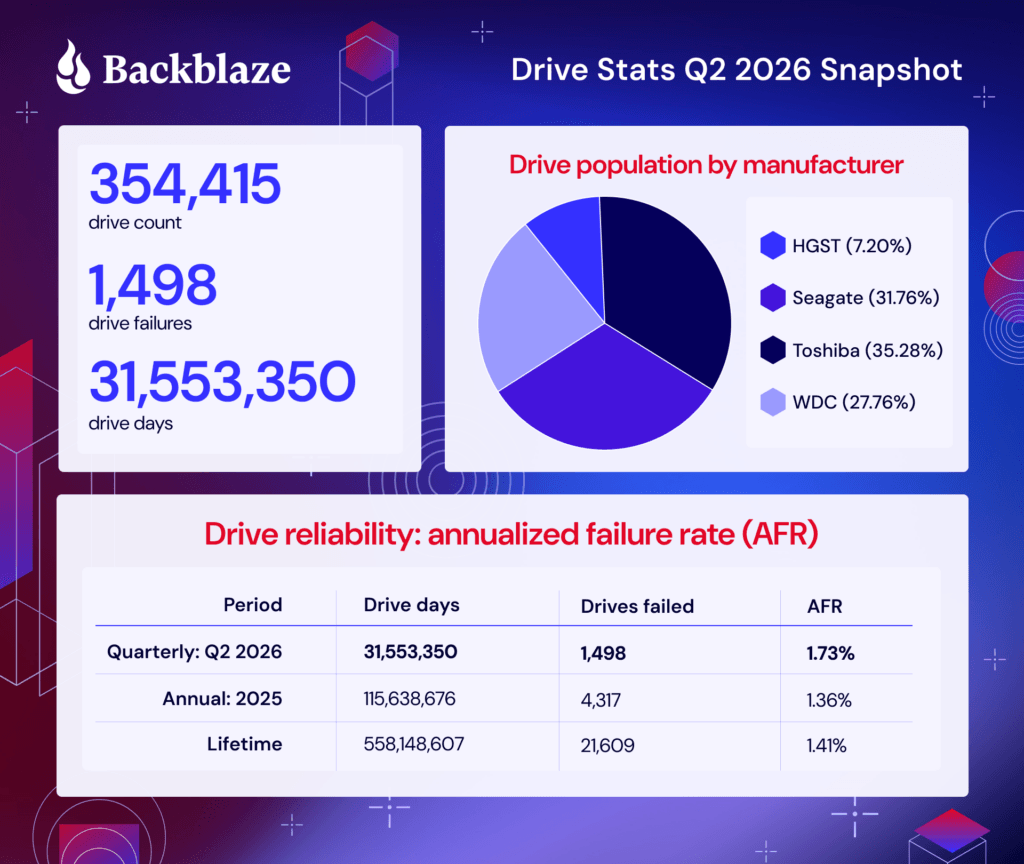
Backblaze published its Q2 2026 drive stats, and the headline number is the one the report spends the most time explaining: an annualized failure rate of 1.73% across 354,415 drives, the highest quarterly figure in quite a while. The causes it names are unglamorous. A handful of aging outliers ran hot, some of them on small samples, and the report says plainly that the spread of models above 3% leaned higher than recent quarters have. Something to keep an eye on, in its words.
The honor roll
Three models went the whole quarter without a single failure: Seagate’s 8TB ST8000NM000A, 12TB ST12000NM000J and 14TB ST14000NM000J. A fourth, the 16TB ST16000NM000J, recorded exactly one. That is a clean sweep for Seagate, the report notes, with no typos involved. On the other end sit three outliers above the 6.95% quartile line: an HGST 12TB at 7.63% after nearly seven years of service, a Seagate 10TB at 9.33% (a small fleet of 965 drives and an average age of eight and a half years), and a Seagate 14TB at 8.26% on similarly short numbers. Age and sample size do most of the explaining.
The big drives keep winning
The 20TB-and-up cohort is now roughly a quarter of the fleet, and its numbers are the best in the report: WDC’s 22TB at 0.55% across 45,665 drives, Toshiba’s 24TB at 0.58%. Both are among the youngest models in the tables, which the report acknowledges, but the gap to the older workhorses is wide enough to be the trend now. Two veteran models retired during the quarter, a 4TB HGST at nearly nine years and an 8TB at nearly eight, and for the second quarter running no new drive model entered the fleet at all.
CMR, SMR, and the horizon
The middle of the report is a patient explainer on CMR versus SMR recording, and where HAMR fits: different techniques for different problems, combinable, with the practical point that shingled drives change what a rebuild costs rather than what a spec sheet says. Backblaze says there are no SMR drives in its fleet today, and promises to flag them if that changes, because the failure tables are only useful if you know what is in them.
My read
The quarter’s rate is noisy, and the report says so: three aging drives did most of the damage, on small samples. The durable signal is in the tables the fleet keeps renewing, where the 20TB-and-up cohort posts numbers that would have raised eyebrows a few years ago. If a build is on your autumn list, the lifetime table is the one to keep open. Back up either way.
Source: Backblaze Drive Stats for Q2 2026.