

Start with the people selling the memory, because they have had an excellent year. Micron told investors on its latest earnings call that it has already sold most of the memory it will make next year, that customers will pay “much higher prices” than this year, and that it sees demand exceeding supply in both 2027 and 2028. “Overall, supply-demand environment is only getting tighter,” the CEO said, with no line of sight to when the balance returns. The unit that sells datacenter memory posted a 90 percent gross margin for the quarter, up from 41 percent a year earlier.
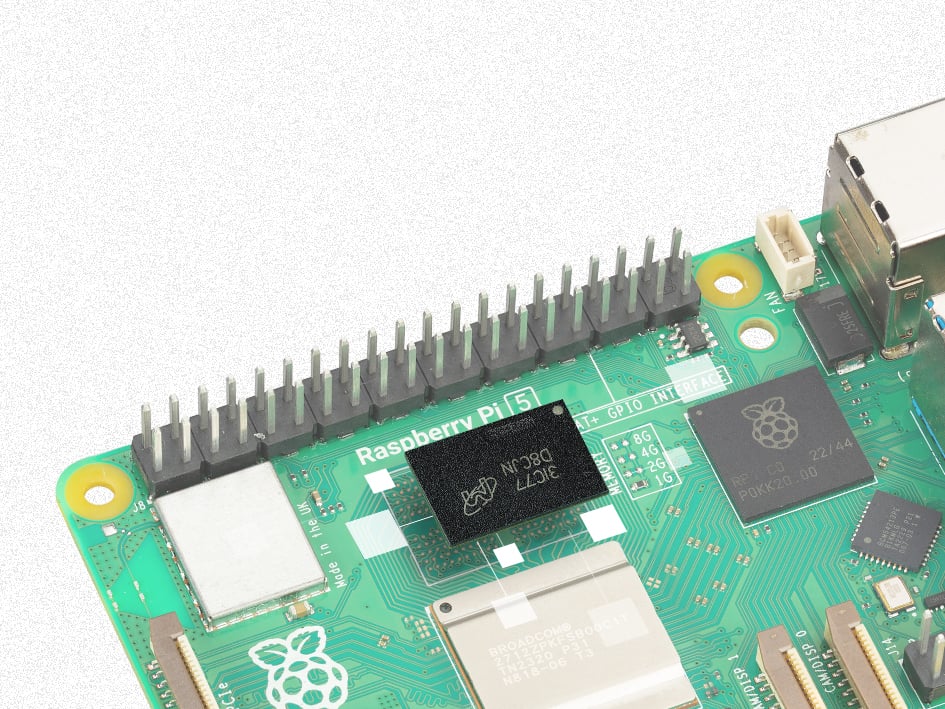
Raspberry Pi sits at the other end of that supply chain. It announced that it is raising the price of the 2GB variants of the Pi 4 and Pi 5 by $12.50, to $67.50 and $77.50. The company says the cost of memory has risen very steeply over the past two years and continues to increase, and that April’s round of increases, when it held the 1GB and 2GB prices down and raised the higher-density models instead, is no longer sustainable.
What changes, and what does not
The 2GB Pi 4 goes to $67.50 and the 2GB Pi 5 to $77.50, an increase of $12.50 each. The 1GB variants of both boards, and the 2GB Compute Modules 4 and 5, keep their prices. That leaves a company whose whole brand is cheap computing in the position of telling customers to buy less computer: the announcement suggests the Pi 3B, 3A+ or 3B+ for tighter budgets, points to its magazine’s memory-optimization guides, and says plainly to make sure you are not paying for headroom you do not need.
There is a second warning in the post, aimed at the gray market: buy from official resellers, because the company knows unauthorized vendors have been inflating prices and selling product that is not what it claims to be. And there is a promise, of a kind: the supply situation “won’t last forever,” and Raspberry Pi looks forward to reversing its own price increases when memory subsides. Micron’s call, from the other side of the same market, is the counterweight: new factories are planned for 2028 and even they will not bring immediate relief.
The part that strains belief
Two gigabytes of RAM now move a Raspberry Pi’s price by $12.50, and the same shortage that justifies it just helped a memory maker to a 90 percent margin. The computers built to be affordable at any scale are the ones absorbing the squeeze first, because a small board has nothing to cut except the part that got expensive.
It gets stranger when you look at what the shortage is made of. The fastest-growing demand is for the high-bandwidth memory that AI accelerators use, and the manufacturing expansion Micron describes, new factories that come online in 2028, is shaped around that world. A Raspberry Pi’s RAM competes for the same scarce capacity, and the sellers expect nothing but further tightening. A $77.50 board is a small customer in that market, and it is priced accordingly.
For anyone planning a small fleet, the budget moved, and the advice to buy 1GB boards or a Pi 3 is sound for a while. The price of a Pi now reflects a memory market with no relief in sight, and the company making the memory expects the tightness to run through 2028. That is the story behind the number.
My read
It is ridiculous in the plainest sense: Raspberry Pi’s prices went up because the price of memory went up, and the shortage behind that is making the memory business a lot of money. Raspberry Pi handled its end about as well as anyone could, with a clear explanation and a promise to reverse the increases when memory subsides. The catch is that the reversal depends on the same companies whose margins depend on nothing changing soon. If you need a Pi now, buy exactly the RAM you need. If you do not need one, waiting looks better than it has in years.
Source: Raspberry Pi’s price announcement and The Register’s report on Micron’s call.