

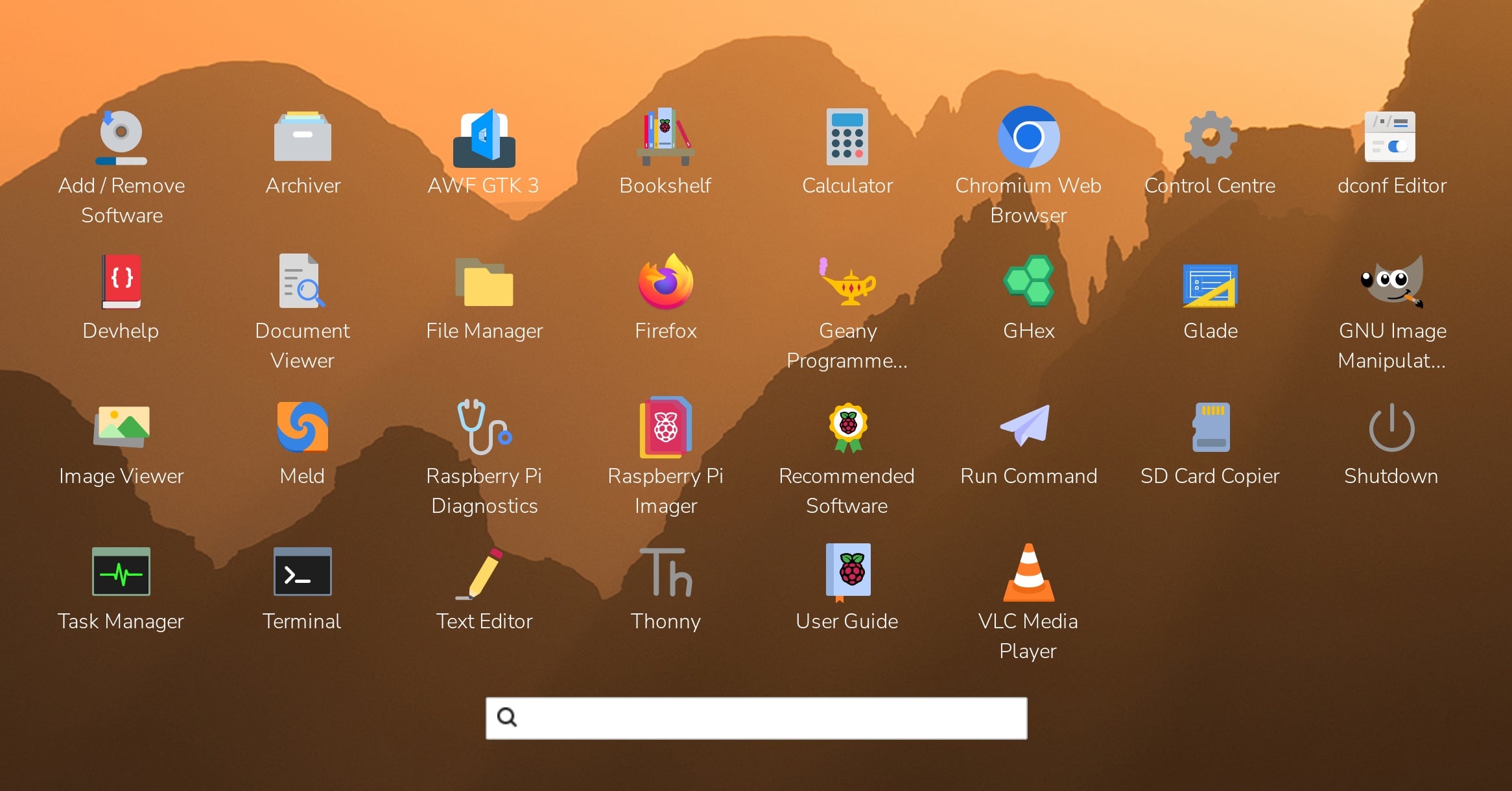
The Raspberry Pi Desktop has looked the same for a decade on purpose, and the release notes date the September update to the 15th. It is the biggest visible change to the desktop in years: an icon dock that can replace the taskbar or sit alongside it, and a full-screen application launcher in place of the main menu. Simon Long, who wrote the announcement, is emphatic that it is optional: unless you switch it on, the desktop looks and behaves exactly as before.
What you get when you do: the dock holds a graphical application launcher with search, drag-and-drop ordering and optional categories, and a combined quick launcher and task list that shows each running application’s window count and jumps between them. A Dock page in Control Centre covers colour, position and icon size, plus the taskbar’s most-requested feature, autohide. A Widgets page moves plugins between taskbar and dock, and the Defaults page flips the whole layout between Taskbar, Dock, and a hybrid of the two.
Smaller changes sit underneath. labwc and wlroots moved to 0.20 while the kernel stays on the 6.18 line, at 6.18.50. The screenshot tool is new, the clock gained an analogue mode, and the desktop background can be drawn by swaybg instead of the file manager, which saves memory if you keep no icons on the desktop. One default changed: external drives no longer automount, handled now by the ejecter plugin.
The RAM lock returned alongside it
The update landed the same week the firmware lock on RAM upgrades resurfaced, because the reason people want more memory is the reason it costs more. A 16 GB Raspberry Pi 5 now runs about $305, and Mike Thompson, who wrote Raspbian, said plainly what that does to the machine’s original purpose. Phil Elwell, a senior principal software engineer at Raspberry Pi, confirmed on the forums in June that newer firmware locks a board to its original RAM size, to remove the reseller incentive to buy small boards, upgrade the memory and sell them as larger models.
The check went in two years ago and never appeared in the bootloader’s release notes, which for 23 September 2024 list only minor manufacturing-test updates. The workaround is simple: the check lives in the bootloader, and 2024-09-10, the last release before it, can be flashed over USB, so a hand-reworked board still boots. Hackaday’s read is that hand rework was never the target; it found fifteen buyers on GitHub sold “upgraded” boards that misreport their own size.
My read
A desktop refresh that refuses to force itself on anyone is rarer than it should be, and the presets are the smart part: the new look is one Control Centre switch away, and so is the old one. The RAM lock is the opposite kind of change: silent, mandatory, and aimed at resellers rather than owners. It is still in force, and the bootloader from before the check still gets a reworked board to boot.
Sources: the announcement by Simon Long on Raspberry Pi’s blog; the Raspberry Pi OS release notes for 15 September; the June forum post by Phil Elwell; the rpi-eeprom 2024-09-23 release notes; Hackaday’s analysis and the linked rpi-eeprom issues; The Register for Thompson’s quote and current prices