KryonOS is a small graphical operating system and JavaScript runtime for the ESP32, and its promise is narrow and specific: flash the board once, and after that apps and updates arrive from an on-device store over Wi-Fi. Apps are JavaScript files running on Duktape, and a file manager and text editor work off the SD card.
What fits in an ESP32
The interesting engineering is all memory. An ESP32-WROOM has about 520 KB of SRAM before the Wi-Fi stack, the filesystem buffers and the kernel take their share, which leaves the JavaScript engine around 90 KB to work with. The runtime forces a garbage collection sweep during every System.delay() call, streams JSON instead of parsing a whole structure in one gulp, and renders graphics in slices: a full 240x320 16-bit canvas would need 153.6 KB, more than the chip can spare, so the engine draws each frame through a 240x32 strip of about 15 KB, pushes it out over DMA, and moves down the screen. The project calls it sliced double-buffering, and it is how the little 3D demos render without tearing.
Apps get JavaScript APIs for GPIO, touch input, the SD card and sensors, and the launcher can suspend and resume them. The touch API carries one reminder of what this is: pressing the top-right corner force-closes the running app, so you cannot lock yourself out of the OS.
What it runs on
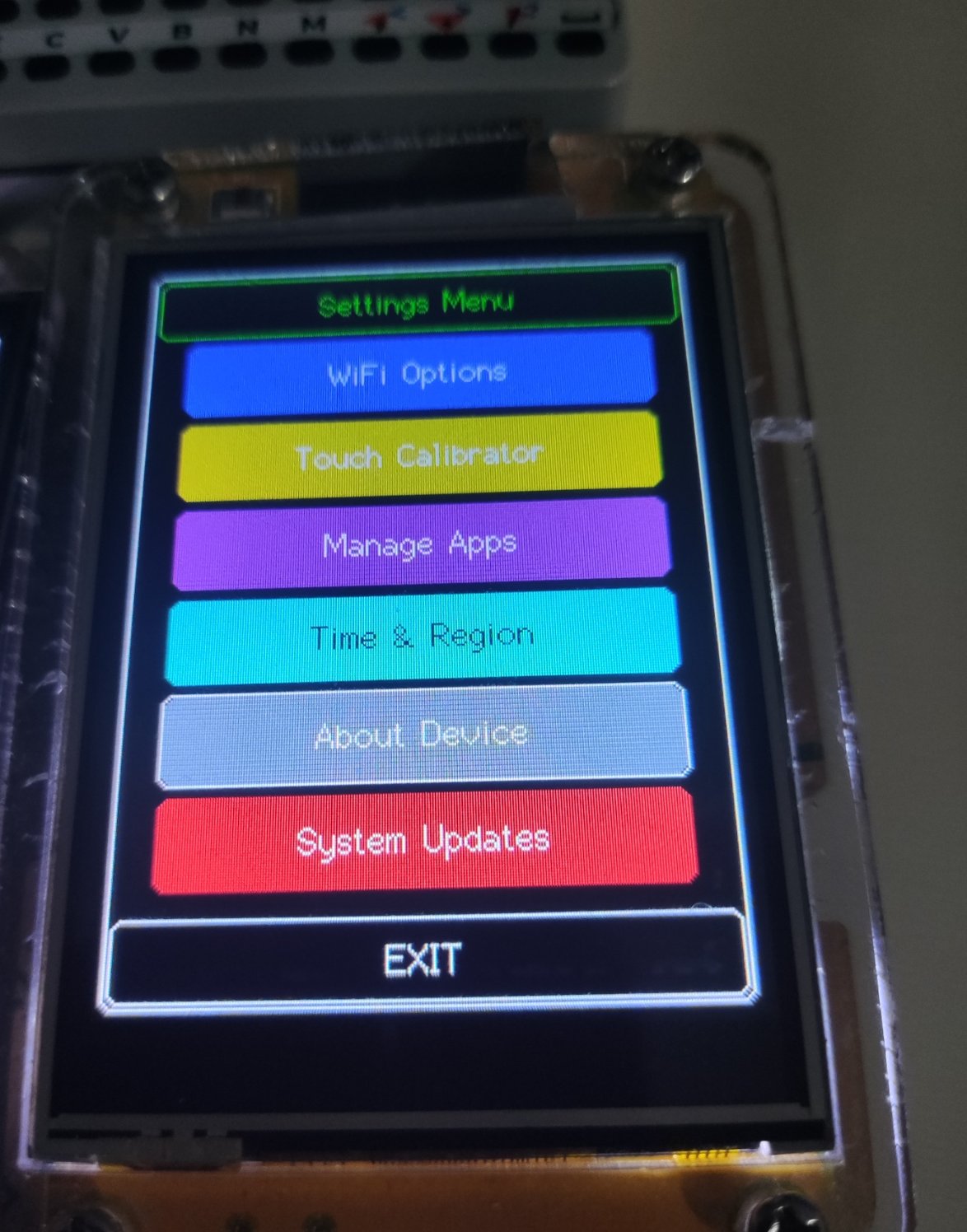
The stable build is an ESP32 (WROOM-32, S2, S3 or C3) wired to a 2.8-inch ILI9341 touch display and a microSD module, with the display and touch on one SPI bus and the card on the other so the two cannot collide. It also matches the ESP32 Marauder v4, v6 and v6.1 pinout out of the box, which means those boards run KryonOS with no rewiring. Three all-in-one boards are supported experimentally: the Cheap Yellow Display, the M5Stack Cardputer and the LilyGO T-HMI.
Firmware flashes from precompiled binaries with esptool or from source with PlatformIO, and the project ships an app development guide and a JavaScript API guide beside the code. It is GPL-3.0, the first release was in June, and the roadmap holds more boards and more hardware APIs: Bluetooth, I2C and SPI sensors, advanced PWM, deep sleep.
My read
Most ESP32 projects with a screen are one firmware, one job. This one is trying to be a platform, and the flash-once app store is what makes it one: the board on your shelf gets new software without a cable. The 90 KB budget keeps it honest hardware rather than a pretend computer, and the Marauder pinout match is a good piece of opportunism. It is a toy, meant for the maker shelf.
Sources: the project repository and its wiki page on the JavaScript runtime.